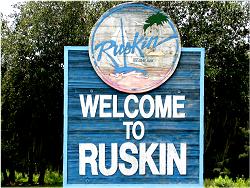
| |
Ruskin, Florida 33570 |
![]() |
In 1910 Dr. George Miller founded a Ruskin College here in what would later become the community of Ruskin. It was based on the principle of combining intellectual endeavors with manual labor, based on the philosophy of Victorian Englishman John Ruskin who fiercely attacked the worst aspects of industrialization, and actively promoted art education and museums for the working classes. Although the school closed during World War I, cooperative governance of Ruskin continued many years under the Commongood Society. |
Go to:
|
Over the years, vegetable farming became a most important industry in Ruskin. With miles of riverfront, bay shoreline and estuaries Ruskin is also a Mecca for boating, fishing & for experiencing the ecology of SouthShore Tampa Bay's wetlands. Read about the Ruskin Community Plan which includes goals for downtown Ruskin; economic development; environment; culture & history; education; College Avenue; transportation; parks & open space and public facilities & services.
Our development will be a mix of retail, office, and residential that will provide the village-like look and feel called for in the Community Plan. The overall project calls for up to 84 residential units. Ruskin Shops, Restaurants, Hotels and Services |
More readings on Ruskin:
SOCIALISM IN THE SUNSHINE:
THE ROOTS OF RUSKIN, FLORIDA
by Lori Robinson and Bill De Young
Today, Ruskin is a quiet Florida town, known primarily for the sweet, red
tomatoes and other
farm produce grown in its clay soil. Only a few street names and the name of
the town itself
remain as vestiges of a dream that brought a small band of settlers to the
Florida pinewoods on
the sparsely settled eastern shore of Tampa Bay. They were utopians from the
North,
intellectuals and farmers in search of a new life and a new community. As
they cut down the
pines from the surrounding turpentine groves and set about building their
community, they
named its shady but rocky streets after some of the men whose principles they
held dear –
Carlyle, Bellamy, and Morris. The newly-born village itself was named after
John Ruskin, whose
ideas and hopes had brought them a new way of life in the Florida wilds.
This cooperative colony was the brainchild of Dr. George McAnelly Miller, a
former Chicago
lawyer and college professor. Born in 1857, Miller had previously been
president of two Ruskin
Colleges, the first in Trenton, Missouri, and the second in Glen Ellyn,
Illinois. Both were
innovative, socialist, workers’ colleges, and had short histories. Internal
strife and strained
relationships with their surrounding communities caused the two colleges to
decline.
Dr. Miller had become the president of Ruskin College in Trenton, Missouri,
in 1900.
Previously named Avalon College, it was founded in 1900 by Mr. and Mrs.
Walter Vrooman as
the central college in the United States for the Ruskin Hall Educational
System of Oxford,
England.1 Based on the English socialist John Ruskin’s ideal of higher
education for the masses,
the college at Trenton, located 100 miles northeast of Kansas City, provided
a Bachelor of Arts
degree to anyone willing to work for it. Students who could not afford to pay
the tuition outright
($120 for forty weeks) could work for their education in the college’s
industries or on its 1800
acre farm. All of them were required to work part of their school day in
enterprises including a
woodwork establishment that made boxes, house furnishings, brooms, and
handles; a factory that
canned the farm’s produce and that of neighboring farmers; a chemical works;
a laundry; sewing
and cooking; and five stores in the town of Trenton. The approximately 500
students were paid
ten cents an hour, and wages covered both board and tuition, but not room
rent, which was fifty
cents a week. The physical work was designed not only to provide a way for
the students to earn
their way through college, but also to train the students “for the practical
duties of life.”2
In 1903 Miller left Trenton in hopes of establishing another Ruskin College.
Internal strife,
financial problems, and a poor relationship with the town forced Miller to
look elsewhere.
Resentment from Trenton’s business community over the college’s cooperative
stores caused
friction between the community and the college, which in turn created
financial losses for the
college.3
Miller chose Glen Ellyn, a suburb of Chicago, where Ruskin College was formed
from an
amalgamation of twelve local colleges in April 1903. The school had an
enrollment of 2500
resident and 8000 correspondence students, with a faculty of 250 professors
and instructors. But
within a year, the college, located in an old hotel and several other
buildings, began a steady
decline. Again, internal strife and problems in the community were the cause.
Miller now
realized that the survival of a workers’ college depended on maintaining a
harmonious
relationship with the surrounding community. In order to form a new college
in its own
sympathetic environment, Miller began searching for a location separated from
the larger
capitalistic community and containing enough land to support a college and
its working
students.4
In 1903, Miller traveled by train to Florida to search again for suitable
land for a Ruskin
College. Unable to find anything to his liking, he boarded a train going
north to return to his
family in Missouri. On the train he began talking to Mr. and Mrs. Norton
Williams, who were
traveling with their children to their summer home in the Carolina
mountains. In Florida they
operated a turpentine still near the eastern shore of Hillsborough Bay. The
Williamses informed
Miller of the area’s advantages, emphasizing Hillsborough County’s rich
forest lands, turpentine
camps, and balmy climate.5
Miller apparently remembered that conversation three years later. In 1906, a
fire caused by
lightning destroyed the college in Glen Ellyn. That same year Miller moved
his family and
belongings to an area south of Tampa called Shell Point. A brother of
Miller’s wife Adaline, A.
P. Dickman, joined the Miller family in Florida in 1907. Dickman and Miller
then negotiated
with Captain C. H. Davis, an extensive landowner along the bay’s lower east
coast, for a tract of
land in southern Hillsborough County. Consisting of 12,000 acres, it
stretched from the Little
Manatee River in the south to Apollo Beach in the north. Davis agreed to
accept 550 acres of
prime Missouri farmland, the combined land holdings of A. P. Dickman and his
two brothers, as
a down payment for 12,000 acres of timber and scrub land in Hillsborough
County. The agreement
was settled on the basis of $3.75 per acre for the Florida land. Part of the
tract was then
platted, and lots were sold even before the other two Dickman brothers and
their families moved
down from Missouri.6
In February 1908, the three Dickman families moved from their Missouri
farmlands to the
wilderness of central Florida. The three brothers regarded the venture purely
in terms of profit,
with no interest in Miller’s socialism. Their farm equipment and stock,
including a team of
mules, a milk cow, oxen, and a matched pair of Berkshire hogs – later
regarded as curiosities in a
land of wild razorbacks – were shipped from Missouri by freight train while
the three families
traveled south by passenger train. From Wimauma, a quickly-growing farm
community and the
nearest railroad depot, the Dickman clan hauled their farm equipment,
animals, and personal
belongings on a rut road eight miles westward to their new home.7
Included with the 12,000 acres they had bought was a deserted turpentine
camp, at one time
operated by convict labor. The new settlers moved into the three wood-plank
supervisors’ houses
inside the convict stockade and quickly converted the camp’s commissary store
into a
schoolhouse. Each family began its own garden and shot the game that was
abundant in the area.
Almost immediately a sawmill was put into operation to provide lumber for the
first temporary
homes and first public school. Wood cut up river was hauled to the water by
mules or oxen and
then rafted down to the Mill.8
The pioneers next turned to making their land available to other settlers.
After reserving
homesteads for themselves and setting aside land for the new college, they
began platting the
entire tract. Through personal letters and advertisements in sympathetic,
usually socialist,
newspapers, the venturous were drawn to the area. The community offered two
advantages:
owning land in a newly-developing communal society and higher education for
their children.9
The four founding families set up the Ruskin Homemakers, an organization for
the distribution
of their land. As more and more people poured into the area, the families
formed a community
association called the Florida Club, which sold land to the new settlers. It
was separate from the
Ruskin Homemakers, but cash received from land sales went to the Homemakers.
Prices for
town lots ranged from $50 to $90. Consisting of about a third of an acre of
land, they measured
90 by 130 feet and included a ten foot alley. Five and ten acre farms cost
$35 to $55 an acre.10
On November 9, 1909, the members of the Florida Club had their first formal
meeting.
Temporary leaders were agreed upon, and the name of the Florida Club was
changed to the
Commongood Society of Ruskin, Florida. At first, meetings were held monthly
and then only as
necessary. The gatherings took place in the Assembly Building, somewhat along
the lines of
New England town hall meetings. A variety of subjects were discussed, and
proposals were
voted upon in a democratic manner by a showing of hands or voice vote.
Trustees and officers
were elected and committees were formed and issued reports. George McA.
Miller played an
important role in these meetings, and his suggestions were usually approved.
Members of the
Dickman families apparently were much less active politically. According to
Arthur McA.
Miller, the founder’s grandson, “the Dickmans were out doing the farming.”
The number of
settlers who attended the meetings of the Commongood Society varied. The
minutes of the
meeting of February 26, 1910, announced that fifty members were present, and
on November 26,
eighty members attended.11
Committees were abundant though they seemed ineffectual. The real work was
done by the
trustees who were led by Miller. Plans for a community newspaper were made,
and the issue of
April 1910 had a run of 5,000 copies. Since the community had nowhere near
5,000 members, it
appears that the Ruskin News might well have been used to advertise the town
to the outside
world. The paper contained only local news. It usually extolled the virtues
of the community,
outlined Commongood Society transactions, and announced details of land
sales.12
As he had done on previous ventures, Dr. Miller modeled his enterprise from
the writings of
John Ruskin. The English socialist believed that higher education should be
made readily
available to the working class, that the social ills caused by the industrial
revolution could only
be eradicated through the education of all people. Working men and women
could only raise up,
but not rise out of, their own class in society by being trained in both
industrial and agricultural
skills. Ruskin believed not only in the education of the intellect, but
placed even more emphasis
on the building of character in education. The cultivation of feelings was
much more important
than the acquisition of the dry facts of knowledge. Also essential was a more
intimate association
with nature. According to Ruskin, the student should not study nature as a
mere spectator, but
should interact with it much like an artist. All students were to do
something with their hands.
Manual labor prepared students as working units of the community. Ruskin
maintained that a
person was not totally educated or happy until he or she became a beneficent
and effective
citizen of the community. Thus, the education of the head, heart, and hand
must be undertaken to
“get that organic cooperation of brain and heart and hand required for the
harmonious
development of human powers. Rooted thus in nature and in manual work, and
fed by a vital and
intelligent teaching of history and of literature, children will grow into
those ‘habits of gentleness
and justice’ which are the supreme end of education.”13
With these ideals in mind, Miller began developing the college. Land on
Ruskin Inlet was set
aside specifically for the college. Funding came from the ten percent
demanded by the
Commongood Society from all proceeds of land sales. The first college
buildings were
dormitories made of rough, unplaned boards, with a basic design that was
simple and box-like.
There was one concrete classroom. What is now the Ruskin Women’s Club served
as the main
classroom building, and the home of Dr. Miller’s daughter Aurora was used as
a music studio.14
Admission to the college called for “a will to work and a desire for
leadership in the liberal
thinking field.” The curriculum offered three years of preparatory work and
four of college
studies. The subjects taught included social sciences, speech, language,
literature, music, drama,
art, and shorthand. As at the college of Trenton, Missouri, needy students
could earn tuition and
board by laboring on the college’s twenty acre farm or in one of its
workshops including
weaving, leather-working, and woodworking. A laundry and a cooperative store
also existed.
The students’ day was broken into three periods: four hours of study, four
hours of classes, and
four hours of work. At its peak, the college had a student body of 160.15
In the early years, the founders of Ruskin hoped that there would develop an
intellectual,
social, aesthetic, and ethical life that would revolve around the college,
one that would benefit
the entire community. The college was not to be merely an institution of
higher learning, but a
school of basic studies for both children and adults. The college performed
classical plays each
month in the outdoor Shakespearian Theater, held weekly literary society
meetings where
students and colonists could exhibit their talents, and offered regular
concerts by the music
department.16
Ruskin College was a strong incentive for luring prospective settlers.
Working-class
Americans, confined to the backbreaking toil of farm or factory, wanted their
children to have a
better chance in life.17 The college offered their children a special type of
education, one that
encompassed John Ruskin’s ideal of the relationship of head, heart, and hand.
Their children
would be educated intellectually and morally, as well as physically. And the
parents themselves,
as part of Ruskin’s community, would also benefit from the college.
Prior to Dr. Miller’s arrival in 1906, and the subsequent flow of new
settlers into the region,
southern Hillsborough County had been sparsely settled. Its few original
inhabitants were not
“crackers,” but “fly-up-the-creeks,” a term used for people who lived out in
the wilderness,
seeming to want to hide from civilization. They lived on the higher spots of
land, avoiding the
flood-prone lowlands, and scratched out a living hunting game and fishing the
river and bay
waters. In what is now a rich agricultural area, farming was avoided.
Turpentine companies had
set up small camps staffed by locals and operated with convict labor. They
drained dry the sap
from vast tracts of pine trees and cut and sold the lumber. The land was then
put up for sale.18
The area was relatively inaccessible. There was a train depot at Wimauma,
eight miles to the
east of the rut road, and there was one bridge across the Alafia River at
Riverview, twelve miles
to the north by posted road. The trip from Tampa by road took eight hours,
but only in good
weather. In wet weather, the roads were usually flooded. A motor launch named
The Lurline
made a regular four-hour run between Tampa and Bahia Beach. Soon after the
arrival of the
three Dickman families in 1908, A. P. Dickman bought a small launch named The
Kilcare, and
this replaced The Lurline from Tampa to Ruskin. A. P. and his son Paul were
in charge of
bringing in new settlers who traveled by train or steamship to Tampa.19
As more settlers bought land in Ruskin, resentment flared between the
“natives” and the
colonists. The newcomers were viewed with rising suspicion as Yankees who
wanted to change
the natives’ culture and livelihood. The establishment of a permanent public
school, with Dr.
Miller’s sixteen-year-old daughter Aurora as its first teacher, turned
resentment into action.
Forest fires were set on the colonists’ land, destroying timber still being
tapped to produce
turpentine, and stacks of cordwood cut for The Kilcare’s boilers were burned
in the middle of the
night.20
Many of the new colonists were veterans of similar hostilities concerning
cooperative
communities that had failed, most notably two colonies in Ruskin, Tennessee,
and Ruskin,
Georgia. The first, located sixty miles west of Nashville, was founded in
July 1894, by Julius A.
Wayland, editor of the popular socialist newspaper, The Coming Nation. The
colony flourished
until 1899, when internal friction caused the dispersal of the inhabitants.
Some 249 residents
moved to a new colony near Duke, Georgia, where for two years they struggled
to farm
worthless, swampy land. The colony at Ruskin, Georgia, collapsed in September
1901. One of
the new colonists in Ruskin, Florida, was Ray Edwards, son of A. S. Edwards,
successor to
Wayland as editor of The Coming Nation.21
Socialist communities had grown in America around the turn of the twentieth
century. The
Depression of 1893, oppressive industrial trusts, and imperialism caused many
people to lose
faith in the American government and the capitalistic dream. Socialism was an
alternative, and
cooperative communities, self-sufficient and separated from the capitalistic
system, were
established as havens from oppression.
After the disintegration of some of these socialist commonwealths in the
early 1900s, the
newly-formed cooperative colony at Ruskin, Florida, appealed to many of the
residents of those
settlements. The dream of a new beginning and the hope for a better future
for their children
lured people to the Sunshine State. But more importantly, Florida itself
beckoned to them.
At the time of Ruskin’s founding, Florida was enjoying a land boom. For years
the state had
been the playground of the rich. When vacationers returned home, they spread
the idea that
Florida could become an agricultural paradise where farmers, weary of the
fruitless struggle
against nature in the North, could make easy fortunes from Florida’s
bountiful soil. Rich
investors, along with the railroads, launched advertising campaigns which
attracted the attention
of small farmers and homeseekers in the frozen North. Florida was portrayed
as a “land of
dreams,” and reports of its wonderful productivity read like fairy tales. It
was a “poor man’s
paradise,” where farmers who had failed in the North could have a second
chance and where
homesteaders could buy up valuable land for next to nothing.22
The scrub and timber lands east and south of Tampa – the “prairie lands” of
central Florida –
were reported to have a fantastic growing season. In ten months, two farm
crops and three truck
crops could be raised on fertile soil.23 In an advertisement in Florida Fruit
and Produce News in
January 1911, the lands fronting Hillsborough Bay were advertised as “one of
the greatest producing
districts in this country from an agricultural and horticultural standpoint.”
It also noted
that the land contained an irrigable belt, a zone of shallow artesian wells
“where ever-flowing
streams of pure water are obtained by boring to a depth of only fifteen to a
hundred feet.” The
Tampa Bay Land Company was selling the land at $60 an acre, in ten-acre
tracts. Tampa, “the
metropolis of South Florida,” was reported to have the best local market for
produce and the best
shipping facilities.24 Thus southern Hillsborough County had an irresistible
pull to many people
seeking new homes and lives. It offered not only the dream of rich farmland,
but the appeal of a
cooperative community and the advantage of education for children.
Selling the land in Ruskin to these people was the main concern of the Ruskin
Commongood
Society. Its object was “to hold and administer for its members the
collectively owned funds,
property, and privileges accruing to them by virtue of their being allotees
of land in Ruskin
Colony.”25 All landholders were members of the Society, and men and women
were eligible to
vote in the affairs of this public body. A portion of all land sold was set
aside for the “common
good.” This land could be used for school grounds, the college campus,
streets, roads, or parks.
Ten percent of all proceeds from allotments went to the Commongood Society to
finance college
and community improvements. Payment for land could be in cash, but new
settlers could also
labor on community projects, such as land clearing, street building, or
dredging, to pay for land.
Laborers were paid in colony “scrip,” sometimes the only money in
circulation. The economy
flourished. By 1910, homes had been built or were being built on both sides
of Ruskin Inlet for a
distance of two miles. Two college buildings and a cooperative store held a
central location. In
November 1910, the Commongood Society administered the sale of 3000 town lots
which the
founders hoped to sell within nine months. They lasted nine weeks. Still
there was a demand for
more land. To accommodate the buyers, 11,000 acres of farm and timber land
ten miles to the
east of Ruskin was bought by an association composed of Dr. Miller, the
Dickmans, and some
prominent citizens of St. Petersburg. The new site was modeled after Ruskin,
and was named
Morris Park, after William Morris of England, the
successor of John Ruskin in the advocacy of
education for the working class. A large pine mill
was put into operation there, and a cypress
shingle mill was begun at Big Cypress, six miles
west of Morris Park. A town site was surveyed,
and colonization soon began. The town was
named Aurazoda, a combination of the names of
Dr. Miller’s daughters.26
The inhabitants of the area quickly realized that
their flat, mucky land made excellent truck
farming areas, and that the climate was ideal for
growing winter vegetables and fruits. State
agricultural officials discovered that the
mineral-rich soil was underlaid with a shell-filled
marl two to three feet below the sandy topsoil. A
marl base allowed irrigation without the loss of
fertilizer, as the marl prevented the fertilizer from
being absorbed too deeply into the soil.27 Also,
numerous artesian wells were dug around the
colony. Many of the deeper wells, those dug from
one to three hundred feet down, were used not
only for irrigation, but, because of their strong
water pressure, also provided water to the second-floor level of Ruskin’s
homes. As agriculture
grew in economic importance, the college became less crucial to the
community.28
Agriculture received a further boost when the railroad connected southern
Hillsborough
County with Tampa. Built with local pine and cypress the tracks were laid in
1913, to connect
Ruskin with the Seaboard Airline Railroad at Morris Park. The railroad’s
primary purpose was to
haul timber to the mill at Morris Park; however, it also had limited, free
passenger service and
mail use. Additionally in 1913, the Atlantic Okeechobee and Gulf Railroad
promised to make
Ruskin the terminus of the suburban service from Tampa, with three round
trips daily, and
pledged to extend the Ruskin-Morris Park interurban from Aurazoda to Tampa
and Bradenton.29
By 1913, travel around Ruskin had been greatly improved. Twenty-five miles of
roads and
ditches had been built, connecting the colonists with each other and the
town. The roads were
reported to be passable at all times. One such road, called “The Wire Road”
because of utility
communications lines running alongside it, linked Ruskin with Tampa. This
later became U.S.
301. In 1914, the colonists decided to build a road that would connect Tampa
with Manatee
County to the south, with bridges across the Alafia and Little Manatee
Rivers. Hillsborough
County commissioners thought that a graded road along the bay was a costly
luxury, one that
would be used only by those “crazy Yankees” trying to homestead the
swamplands of southern
Hillsborough. They refused to have anything to do with it. Instead, the
colonists who believed
that this road was essential to deliver their produce to neighboring towns
passed a local bond
issue for $30,000. A nine-foot shell road was built, which later because U.S.
41. Shortly after its
construction, the road was damaged severely when a Ringling Brothers Circus
caravan, after a
show in Tampa, came through the area during a rainstorm. In 1916, the road
was rebuilt from
asphalt paving blocks to a width of twelve feet. This time the county
commission favored the
improvement, perhaps because one of the commissioners had an interest in an
asphalt paving
plant. By 1922, U.S. 41 had expanded to four lanes and was advanced to a
width of twenty-four
feet.30
Additional sources of transportation for the colonists were the small
launches that made regular
trips between Tampa and Ruskin. The Kilcare left Ruskin at seven in the
morning on every
Monday, Wednesday and Friday, and arrived in Tampa at 10:00 a.m. It left
Tampa at 2:30 in the
afternoon to return to Ruskin. The voyage cost fifty cents each way. The
Bessie, The Isadore, and
The Nokomis were located at the foot of Whiting or Washington Streets, and
made frequent trips
to Ruskin.31
Although connected with its neighboring towns by rail, ship, and highway,
Ruskin remained
somewhat isolated by its own choice. Many colonists had learned through
previous experiences
that outsiders were distrustful of socialism, a system that was perceived as
a threat to the
American way of life. Nevertheless, the colonists depended for their
livelihood on the sale of
their produce to neighboring areas. Pepper, squash, carrots, and cabbage were
Ruskin’s major
crops, with carrots and cabbage grown for the market in Tampa. These were
taken to the
streetside markets along 7th Avenue and 40th Street in Ybor City, where the
Ruskin farmers and
Latin vegetable peddlers bargained over the produce. The Latins then loaded
the goods onto
horsedrawn wagons, and sold them in the residential streets of Tampa.
Eventually a farmers’
market was built by the merchants and peddlers at East Broadway and 47th
Street.32
Throughout Ruskin’s early years, life was generally peaceful. People were
notified of
important events, such as a fire or a meeting, by a bell rung in the
community center. There was
no fire department, only a bucket brigade. The town church was nonsectarian.
Services were held
in the college’s assembly hall, and Dr. Miller usually read from his
translations of original
Hebrew and Greek Bible verses. A. P. Dickman ran the daily newspaper, and his
daughter
Pauline delivered milk to the local farms. Boys earned extra money by
shooting alligators and
selling their hides. The colonists built their own cannery, operating the
whole process, including
soldering the cans by hand, without outside assistance. By 1913, Ruskin had a
local and long
distance telephone system and electric light plant, and its cooperative store
was doing a $25,000
a year business. The colony itself was expanded. Land was bought northward to
extend the
artesian belt and included more timber acreage, and purchases were made
southward to add more
truck farming and citrus land.33
Cooperation was continually stressed. The colonists labored on public works
projects to pay
for their land, and college students worked in the fields and cooperative
industries to pay for
their education. The concept of the “common good” was the motivation for the
colony. To this
end, it tried to promote “social purity.” To keep the community pure, no
liquor or cigarettes were
allowed into the colony. Only whites could lease colony land. However, women
had the same
privileges as men. Dissidents or undesirables were removed by means of a
“reverter clause,” a
legal loophole included in the land deed.34 This clause had the effect of
making it easy for the
Commongood Society to remove a member with the least amount of legal
formality. In such
cases the land would “revert” back to the Commongood Society.
In 1914 the Ruskin Colony Farms newspaper described the Ruskin Community
ideals as:
R ight Relationship I ndividuality
U nited Effort D ignity of Labor
S ocial Purity E nnobling of Character
K nowledge Unfettered A Home for Everyone
I ndustrial Education L ink Head, Heart and Hand
N ew Thought S ex Equality
As utopian as Ruskin seemed, many of its young people became dissatisfied
with its tedious
small-town life. Higher wages and the appeal of the big city prompted the
young to begin
drifting away. World War I emptied Ruskin of most of its remaining young
adults. The men were
drafted, and the women took government jobs away from home. The college was
closed. In
1918, a disastrous fire destroyed all but one of the
college buildings. The final blow to the college
came in August 1919, when Dr. Miller died
suddenly while on a lecture tour in Ohio. He had
gone there to promote his book The New Order of
Jesus and to recruit new settlers and students for
Ruskin. The college would never reopen.35 Few of
Ruskin’s young people returned after the war.
They had seen the outside world and succumbed
to its temptations. However, one young man who
did return was A.P. Dickman’s son Paul, who
immediately set up a sawmill operation.
In the 1920s there was another land boom in
Florida, and Paul Dickman was busy buying and
selling real estate in Tampa. But, prosperity was
shortlived. The bubble of land speculation burst
around mid-decade, and the Crash of 1929 left
many people deeper in debt, including Paul
Dickman. His 2500 acres of farmland in Ruskin
constituted all of his assets. However, he
weathered the Depression and became Ruskin’s
leading farmer, instituting new farming techniques
into the area. Dickman taught Ruskin farmers how
to farm for a profit, and he built his own cultivating machines specially
suited to the Florida soil.
He discovered that the marlbased earth was perfect for growing tomatoes, and
the new Ruskin
vegetable industry was begun. In 1941, Dickman organized the growers into the
Ruskin
Vegetable Cooperative. They pooled their produce and figured out innovative
ways of packaging
and shipping their fruits and vegetables by using cellophane wrappers and
refrigerated trucks.36
Their success earned Ruskin the nickname: “America’s Salad Bowl.”
During World War II, Tampa and Ruskin developed a closer relationship. Many
people from
Ruskin found work in Tampa’s shipyards and sulpher plants, while many Tampans
chose to live
in Ruskin as Hillsborough’s newest residential area. In the last two decades,
Ruskin has
blossomed into its present agricultural greatness. It grows about 3000 acres
of tomatoes yearly,
and nearby Apollo Beach has one of the largest and most modern tomato
packinghouses in the
world. Also important to the area are phosphate mining and shipping, flower
and tropical fish
farms, and real estate.37
As a result of George Miller’s dream of a college within a supportive,
socialistic community,
the town of Ruskin was founded. Miller’s cooperative community surrounding
and supporting a
socialist workers’ college lasted barely a decade. Nevertheless, the
Commongood Society,
though generally inactive, existed until October 1967, when it quietly
dissolved. Speaking of the
old community, Arthur McA. Miller reflected: “I’d really prefer to call it a
communitarian or
communalistic experiment, rather than socialist or communist. It really
wasn’t.”38 Because
George Miller had depended on his wife’s brothers, three Missouri farmers, to
help him finance
and organize the colony, and because the community itself was colonized by
farmers, Ruskin
survived and flourished in an agricultural setting. In the process, the
triumph of capitalism nearly
erased memories of the town’s radical roots.
1 William Ray Denslow, Centennial History of Grundy County, Missouri
(Trenton, Missouri: by author, 1939), p.
242.
2 George McA. Miller, “The School in the Promotion of Progress,” Arena 28
(September 1902): 234-37; Thomas
Elmer Will, “A College for the People,” Arena 26 (July 1901): 17.
3 The Story of an Old Town – Glen Ellyn (Glen Ellyn, Illinois: Anan Chapter,
D.A.R., 1928), p. 36; Denslow,
Centennial History of Grundy County, p. 244.
4 George McA. Arthur, “An Academic Center for the New Education,” Arena 29
(June 1903): 605-07; Frederick S.
Weiser, Village in a Glen (n.p., 1957), p. 75; The Story of an Old Town –
Glen Ellyn, p. 36; Interview with Paul
Dickman, Ruskin, Florida, April 1974.
5 “The Early History of Ruskin,”Notes Based Upon the Williams Family and
Other Area Residents, etc., Notes
Based Upon Mr. Paul Dickman and Other Area Residents, no author, no date,
vertical files, Hillsborough County
Preservation Board, Tampa, p. 1.
6 Jim Gallery, “Ruskin: Comin’ Up Roses,” Bradenton Herald, Dec. 5, 1965, p.
4; “The Early History of Ruskin,” p.
1.
7 Paul Dickman Interview; Virginia Davis, “Yankees Made Ruskin Home in 1908,”
Tampa Times, 24 August 1967,
p. 2-A. “The Early History of Ruskin,” p. 2.
8 Mark Fisher, “Ruskin Church Celebrates 50 Years,” Tampa Tribune, 3 Oct.
1974, p. 10-F; Paul B. Dickman,
speech for the 50th anniversary of the Ruskin United Methodist Church, 27
Oct. 1974, vertical files, Ruskin Public
Library, Ruskin, Florida, p. 4.
9 Interview with Arthur McA. Miller, April 1974.
10 Ruskin News, April 1910; “Geographical Growth,” Ruskin Colony Farms, 1914,
p. 1; Walt Robshaw, “Ruskin
Days Mark 50th Anniversary,” Tampa Times, 1 March 1960, p. 4.
11 Commongood Society of Ruskin, Florida. Formal minutes of meetings,
1909-1910; Interview with Arthur McA.
Miller.
12 Ruskin News, April 1910.
13 J. A. Hobson, “John Ruskin as Social Reformer,” The Bookman 35 (Oct.
1908): 25-26; Jason Amus Russell,
“Ruskin the Educator,” Education 49 (Dec. 1928): 248.
14 Noretta D. Sheffield, “Ruskin Commongood Society,” 13 March 1963, vertical
files, Ruskin Public Library, P. 10;
“The Early History of Ruskin,” p. 5; Gloria Jahoda, River of the Golden Ibis
(New York: Holt, Rinehart & Winston,
1973), p. 352.
15 Sheffield, “Ruskin, Commongood Society”; “Two-Day Program to Mark Ruskin
50th Anniversary,” Tampa
Tribune, 24 March 1960, p. 2-B; Willard Dickman Miller, Bahia Beach Then and
Now (Tampa: Logan Printing Co.,
1961); James W. Covington, The Story of Southwestern Florida (New York: Lewis
Historical Publishing Co., 1957),
pp. 1, 314.
16 “Deeds of Daring Dreamers”; Ruskin Colony Farms, 1914, p. 1; Arthur Mc.A.
Miller Interview; Interview with
Willard Miller, March 1974.
17 Karen De Young, “Ruskin: The Years Wear Thin a Dream,” St. Petersburg
Times, 9 May 1974, p. 3-D.
18 Davis, “Yankees Made Ruskin Home in 1908”; “The Rush for Land in Florida,”
Florida Fruit and Purchase
News (Tampa), 3 June 1910, p. 4.
19 Willard Miller Interview.
20 “Two-Day Program to Mark Ruskin 50th Anniversary,” Tampa Tribune, 24 March
1960, p. 2-B.
21 Jaclyn Dalrymple, “Ruskin Began as a Socialist Experiment, Historian
Says,” Tampa Tribune, March 3,1974, p.
2-B; Charles H. Kegel, ed., “Earl Miller’s Recollections of the Ruskin
Cooperative Association,” Tennessee
Historical Quarterly 17 (March 1958): 45; Kegel, “Ruskin’s St. George in
America,” American Quarterly 9 (Winter
1957): 416, footnote 19.
22 “The Poor Man’s Paradise,” Florida Fruit and Produce News, 24 Dec. 1909,
p. 1.
23 “The Prairie Lands of Central Florida are the Finest Conceivable for
Trucking and Farming,” Florida Fruit and
Produce News, 6 May 1910, p. 14.
24 “The Logical Point for the Truck Grower” (advertisement), ibid., 6 Jan.
1911, p. 20.
25 “By-Laws of the Ruskin Commongood Society of Ruskin, Florida,” Minutes
Book #3, 26 Feb. 1910, p. 150.
26 Sheffield, “Ruskin Commongood Society,” p. 10; Ruskin News, April 1910;
“Deeds of Daring Dreamers.”
27 “The Early History of Ruskin,” p. 5; Federal Writers’ Project in Florida,
Works Progress Administration,
American Guide Series: Florida, Seeing Tampa: A Guide and Handbook of
Information to the City and Its Suburbs
(New York: Bacon, Percy and Dagett, 1941), pp. 121-122. “The Early History of
Ruskin,” p. 5; Federal Writers’
Project in Florida, Works Progress Administration, American Guide Series:
Florida, Seeing Tampa: A Guide and
Handbook of Information to the City and Its Suburbs (New York: Bacon, Percy
and Dagett, 1941), pp. 121-122.
28 M. C. Bob Leonard, “Ruskin Topics: Notes on Hillsborough’s Utopian
Community,” for Ybor Special Collection,
Hillsborough Community College, Tampa, 10 March 1977, P. 3; “Interurban
Railroad Development Planned by
Ruskin Colonists,” Tampa Tribune, 2 February 1913, p. 23; “The Early History
of Ruskin,” p. 5.
29 “Interurban Railroad Development Planned by Ruskin Colonists,” pp. 18, 23.
30 Ibid., p. 23; Davis, “Yankees Made Ruskin Home in 1908”; “The Early
History of Ruskin,” p. 3.
31 Leonard, “Ruskin Topics,” p. 2.
32 Karen De Young, “Ruskin,” P. 3-D; “The Early History of Ruskin,” p. 6.
33 “The Early History of Ruskin,” p. 4; ‘Interurban Railroad Development
Planned by Ruskin Colonists,” P. 23;
Leonard, “Ruskin Topics,” pp. 3-4.
34 Ruskin Colony Farms, 1914.
35 Arthur McA. Miller Interview.
36 Karen De Young, “Ruskin,” p. 3-D.
37 Gallery, “Ruskin”; Darlene Carter, “Ruskin Center of Growing South
Hillsborough,” Tampa Times, 9 Feb. 1970,
p. 2-H; Robshaw, “Ruskin Days.”
38 Arthur McA. Miller Interview.