| |
St. Petersburg on Tampa Bay |
|
|
Photo Tours:
Find
Local Hotels |
|
![]() |
![]() |
|
![]() |
![]() |
|
![]() |
![]() |
|
![]() |
![]() |
|
|
|
||
|
Return to the St.
Petersburg Home Page |
Photo Tours: |
|
©
"GoThere®
before you go there"
From Wikipedia, the free encyclopedia
Nickname: "Florida's Sunshine City"
Location of the city proper in the state of Florida
Coordinates: 27°46′15″N, 82°40′45″W
Country United States
State Florida
County Pinellas County
Founded 1876
Incorporated February 29, 1892
Mayor Rick Baker
Area
- City 344.7 km˛ (133.1 sq mi)
- Land 154.4 km˛ (59.6 sq mi)
- Water 190.2 km˛ (73.4 sq mi)
Elevation 13 m (43 ft)
Population
- City (2000) 248,232
- Density 1,607.3/km˛ (4,163.1/sq mi)
- Metro 2.6 million
Time zone Eastern (EST) (UTC-5)
- Summer (DST) EDT (UTC-4)
St. Petersburg (often referred to by locals as St. Pete) is a city in Pinellas
County, Florida. The city is known as a vacation destination for North American
and European vacationers, as well as a politically important battleground in
U.S. Presidential politics and the home of the highly regarded St. Petersburg
Times. As of the 2000 census, the city population was 248,232. As of 2004, the
population recorded by the U.S. Census Bureau is 249,090 [1], making it the
fourth largest city in the state of Florida. St. Petersburg is the second
largest city in the Tampa-St. Petersburg-Clearwater metropolitan area, which is
composed of roughly 2.6 million residents, making it the second largest
Metropolitan Statistical Area in the state behind Miami-Fort Lauderdale-West
Palm Beach, and the third largest in the southeast.
The city is located on a peninsula between Tampa Bay and the Gulf of Mexico. It
is connected to the mainland to the north, connected with the city of Tampa,
Florida to the east by causeways and bridges across Tampa Bay, and to Bradenton,
Florida in the south by the Sunshine Skyway Bridge (Interstate 275), which
traverses the mouth of the bay. It is also served by Interstates 175 and 375,
which branch off of 275 into the southern and northern areas of downtown
respectively.
With a purported average of some 360 days of sunshine each year, it is nicknamed
"The Sunshine City." For that reason, the city is a popular tourist, and
retirement destination, especially for those in the United States from colder
Northern climates particularly New York, Detroit, and Chicago.
The city was co-founded by John C. Williams, formerly of Detroit, Michigan, who
purchased the land in 1876, and by Peter Demens, who was instrumental in
bringing the terminus of a railroad there in 1888. St. Petersburg was
incorporated on February 29, 1892, when it had a population of only some 300
people.
It was named after Saint Petersburg, Russia, the birthplace of Peter Demens. A
local legend says that John C. Williams and Peter Demens flipped a coin to see
who would have the honor of naming the city. Peter Demens won and named the city
after his birthplace, while John C. Williams named the first hotel after his
birthplace, Detroit. The Detroit Hotel still exists downtown.
The city's first major industry was born in 1899 when Henry W. Hibbs, 1862-1942,
a native of Newport, North Carolina, established his wholesale fish business at
the end of the railroad pier, which extended out to the shipping channel. Within
a year, Hibbs Fish Company was shipping more than 1,000 pounds (454 kg) of fish
each day.
Dredging of a deeper shipping channel from 1906 to 1908 opened St. Petersburg to
larger shipping. Further dredging improved the port facilities through the
1910s. By then the city's population had quadrupled to 4,127.
In 1914, airplane service across Tampa Bay from St. Petersburg to Tampa and back
was initiated, generally considered the first commercial airline. The company
name was the "Airboat Line" and the pilot was Tony Jannus. The Tony Jannus award
is presented annually for prestigious work in the airline industry. There is
also a very popular local music/entertainment venue named after Tony Jannus
called Jannus Landing on Central Avenue in Downtown. Air service was
discontinued in 1924 with the opening of Gandy Bridge, the first across Tampa
Bay, which allowed automobile traffic between the two cities.
The city population continued to multiply during the twentieth century through
the 1970s as the town became a popular retirement destination for Americans from
midwestern cities, reaching 238,647 in the 1980 census. By the 1980s, however,
the population had levelled off, and has grown by only 10,000 since then,
primarily as a result of being "built-out".
Geography
St. Petersburg is located at 27°46′56″N, 82°40′3″W (27.782254, -82.667619)GR1.
According to the United States Census Bureau, the city has a total area of 133.1
square miles (344.7 km˛)— 59.6 square miles (154.4 km˛) of it is land and 73.4
square miles (190.2 km˛) of it (55.19%) is water.
Demographics
As of the censusGR2 of 2000, there were 248,232 people, 109,663 households, and
61,630 families residing in the city. The population density was 4,163.1 persons
per square mile (1,607.3/km˛). There were 124,618 housing units at an average
density of 2,090.0 per square mile (806.9/km˛). The racial makeup of the city
was 71.36% White, 22.36% African American, 0.31% Native American, 2.67% Asian,
0.05% Pacific Islander, 1.07% from other races, and 2.17% from two or more
races. Hispanic or Latino of any race were 4.23% of the population.
There were 109,663 households out of which 24.0% had children under the age of
18 living with them, 38.3% were married couples living together, 13.8% had a
female householder with no husband present, and 43.8% were non-families. 35.6%
of all households were made up of individuals and 13.1% had someone living alone
who was 65 years of age or older. The average household size was 2.20 and the
average family size was 2.88.
In the city the population was spread out with 21.5% under the age of 18, 7.7%
from 18 to 24, 30.2% from 25 to 44, 23.1% from 45 to 64, and 17.4% who were 65
years of age or older. The median age was 39 years. For every 100 females there
were 91.2 males. For every 100 females age 18 and over, there were 87.7 males.
The median income for a household in the city was $34,597, and the median income
for a family was $43,198. Males had a median income of $30,794 versus $25,860
for females. The per capita income for the city was $21,107. About 9.2% of
families and 13.3% of the population were below the poverty line, including
19.1% of those under age 18 and 10.8% of those age 65 or over.
Attractions and points of interest
The barriers in the foreground mark the border of the Honda Grand Prix
racetrack.St. Petersburg has a branch of the state university, the University of
South Florida St. Petersburg, as well as St. Petersburg College and Eckerd
College. The Poynter Institute, a school for journalists, future journalists and
teachers of journalism, is also located in St. Petersburg. The non-profit school
is the owner of the St. Petersburg Times, a unique arrangement engineered by the
founder of both, Nelson Poynter. The city has a children's museum (Great
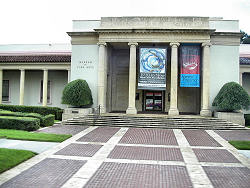
Explorations), Museum of Fine Arts, a History Museum, a Holocaust Museum and the
Salvador Dalí Museum, which houses the largest collection of Dalí's work outside
of Europe, including a number of famous and large-scale paintings such as The
Discovery of America by Christopher Columbus. There are also various other
smaller art galleries and entertainment venues, especially in the Downtown area,
which has seen a boom in development since the mid 1990s.
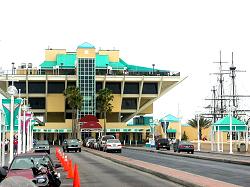
The St. Petersburg Pier contains a small aquarium open to the public. Retail
shopping, adventure activities, and dining- most notably the historic Columbia
Restaurant, are also located at the Pier. Dolphin sight-seeing boats depart from
The Pier to tour Tampa Bay. You can also rent boats to charter or captain
yourself. Frequently docked at The Pier is the replica of the HMS Bounty used in
the 1962 MGM movie starring Marlon Brando. The Bounty charges a fee for tours,
and has recently returned from filming the sequel to Disney's Pirates of the
Caribbean. This replica was also used in the filming of the 2005 adult movie
Pirates.
Downtown is the location of the Baywalk shopping complex, home to a Muvico 20
screen movie theater, as well as many chain restaurants and retail shops,
catering to more of a middle and upper class audience. North of downtown is
Great Explorations, The Children's Museum, a fun, interactive museum with many
new exhibits, including a children's village with giant pretend stores, Fire
House and Pet Vet Clinic, and preschool, science, music, art, and water
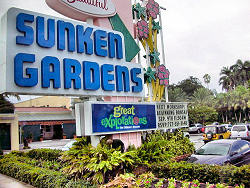
exhibits. The museum is located next to the Sunken Gardens (Florida) site, home
to the gardens themselves, and a stretch of fine dining (on newly developing 4th
Street) that includes many nationally recognized restaurants as well as numerous
local specialties. Every Saturday morning, from October to April, the downtown
area holds a farmers market, of sorts. Local produce farmers can be found
selling their fruits up and down the downtown region, as well as live bands,
barbeque vendors, and artists of all kinds. The locally renowned "Ringside Cafe"
features live Blues music every night from various musicians, and is always a
hotspot among the locals.
The Wikimedia Foundation is also based in St. Petersburg, as was Wikia, Inc.
before its re-incorporation in Delaware.
Sports
Club Sport League Stadium
Tampa Bay Buccaneers Football National Football League (NFL) - NFC Raymond James
Stadium
Tampa Bay Lightning Hockey National Hockey League (NHL) - Eastern Conference St.
Pete Times Forum
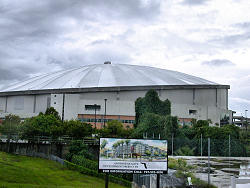
Tampa Bay Devil Rays Baseball Major League Baseball - AL Tropicana Field, St.
Petersburg
Tampa Bay Storm Arena Football Arena Football League (AFL) St. Pete Times Forum
St. Petersburg is represented by teams in four major professional sports. One,
the Tampa Bay Devil Rays of Major League Baseball, plays in St. Petersburg
proper, while the other three play across the bay in Tampa. All of the teams are
considered to represent the entire Tampa Bay metropolitan area. The Devil Rays
began play in 1998, but have yet to be a major contender - finishing last in the
American League's East Division in eight of the nine seasons they have played.
Tropicana Field, the home venue of the Devil Rays, played host to the 1999 Final
Four. St. Petersburg is also home to the Honda Grand Prix of St. Petersburg, the
inaugural race was held in April 2005. The circuit itself is made of downtown
streets passing Progress Energy Park, the marina, and a runway in Albert Whitted
Airport, and streets are temporarily blocked off for the annual Indy Racing
League race, which was last held on April 2, 2006. The race has been confirmed
to return from March 30 - April 1, 2007.
St. Petersburg is the home of many past, present, and future sports icons. In
the area of hails the WBC and IBF Light Middleweight Champion Ronald "Winky"
Wright and IBF, IBO, and WBO Champion Jeff Lacy. Football is a big interest in
the area. Ernest Givins, Stacey Simmons, William Floyd, and Pat Terrell are some
of the famous retired NFL players from the city. Shaun King, Marquell Blackell,
Aveion Cason, Darren Howard, Tim Carter, Kenny Heatly, and DeAndrew Rubin are
some players currently in the NFL from the city. Sam Smith, Andre Hall, Mike
Ross, Jason Teague, Chris Davis, Billy Henderson, Chris C. Davis, Omonigho
Imeokparia, Jovon Jackson, Pat Carter, Kevon Marion, and Ralph "Ricky" Willams
are some players looking to enter the NFL in the next couple of years. Current
Devil Rays pitcher Doug Waechter is also from St. Pete, and current Indy Racing
League driver and 2005 Indianapolis 500 Champion Dan Wheldon resides in St. Pete
as well.
Trivia
About one-third of Ian Fleming's James Bond novel, Live and Let Die, is set in
St. Petersburg.
Bayfront Medical Center is the city's largest hospital and has a
flight-evacuation program (Bayflite).
Sister cities
Takamatsu, Japan
Saint Petersburg, Russia ("twin city" relationship)
Notable residents
Charlie Crist, Governor-elect, 2006
Angela Bassett, Leading Actress
Bob Devin Jones, playwright
Nicole Haislett, freestyle swimmer
Jack Kerouac, leading figure of the beat generation
Jeff Lacy, professional boxer
Tony Little, fitness guru
Lary Crews, writer
John Loftus, former U.S. Justice Department Nazi war crimes prosecutor, the
president of the Florida Holocaust Museum, and terrorism expert
Jimmy Wales, founder of Wikipedia
Dan Wheldon, race car driver
Winky Wright, professional boxer
Bill Klase, martial arts expert, bail agent
Billy Corgan, Smashing Pumpkins band member
Gordon Mackenzie, former Major League Baseball player and minor league manager.