|
|
![]() |
![]() |
![]() |
![]() |
![]() |
![]() |
![]() |
![]() |
![]() |
![]() |
St. Augustine Photo tours: |
Sponsored Links: |
Return to The Florida Home Page
Castillo de San
Marcos
From Wikipedia, the free encyclopedia
Location: St. Augustine, Florida, USA
Nearest city:
Coordinates: 29°54′14″N, 81°18′56″W
Area: 320 acres (1.29 km²)
Established: October 15, 1924
Visitation: 600,252 (in 2005)
Governing body: National Park Service
The Castillo de San Marcos The Castillo de San Marcos is a Spanish built fort
located in the city of St. Augustine, Florida. It was known as Fort Marion from
1821 until 1942, and Fort St. Mark from 1763 until 1784 while under British
control.
Early history
The city of St. Augustine was founded in 1565. Over the next one hundred years,
the city was defended by nine wooden forts. Following an attack in 1668, it was
decided by the Queen Regent of Spain, Mariana, that a masonry fortification be
constructed to protect the city. In October 1672 construction began on the fort
that would become the Castillo de San Marcos.
Construction
The Castillo is made of a stone called "coquina", literally "little shells".
This is what the stone is made of, ancient shells that have bonded together to
form a type of stone, similar to limestone. Workers were brought in from Havana,
Cuba to construct the fort. The coquina was quarried from Anastasia Island
across the bay from the Castillo, and ferried across to the construction site.
Construction lasted twenty-three years, being completed in 1695.
First test
In 1670, Charles Town (modern-day Charleston, South Carolina) was founded by the
British. This was one of the events that spurred the forts construction, being
just two days sail from St. Augustine. In November 1702, forces under orders
from Governor James Moore of Charles Town, set sail from Carolina in an attempt
to capture the city.
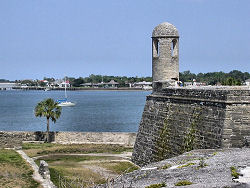
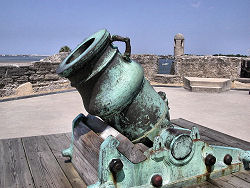
A view of a bastion of Castillo de San Marcos Upon their arrival at St.
Augustine, the British laid siege to the city. All of the city's residents, some
1,200 people, along with all of the fort's soldiers, some 300, remained
protected inside the wall of the fort for the next two months during the siege.
The British cannon had little effect on the walls of the fort. The coquina was
very effective at absorbing the impact of the shells, causing very little damage
to the walls themselves. The siege was broken when the Spanish fleet from
Havana, Cuba arrived, trapping the British in the bay. The British were forced
to burn their ships to prevent them from falling into the Spaniard’s hands, and
march overland back to Carolina. As they withdrew, they set fire to the city of
St. Augustine, burning much of it to the ground.
Second period of construction
After the siege of 1702, the Castillo underwent a period of reconstruction.
Beginning in 1738, the interior of the fort was redesigned and rebuilt. Interior
rooms were made deeper, and vaulted ceilings replaced the original wooden ones.
The vaulted ceilings allowed for better protection from bombardments and allowed
for cannon to be placed along the gun deck, not just at the corner bastions. The
new ceilings required the height of the exterior wall to be increased from 26 to
33 feet.
Second British siege
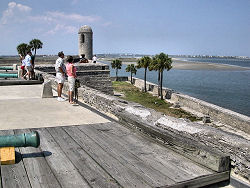
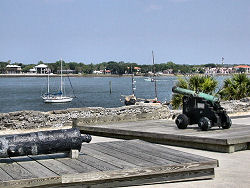
Cannons over the Castillo de San MarcosTensions between England and Spain had
been on the rise for years, and in 1739, Britain declared war on Spain, the
conflict known as the War of Jenkins' Ear. As part of the war, British General
James Oglethorpe laid siege to the Castillo and the city of St. Augustine.
Governor Manuel de Montiano, the Spanish governor of St. Augustine, prepared the
defenses of the Castillo and the Spanish colony. Oglethorpe set out from the
newly created colony of Georgia and invaded Spanish held land. After capturing
the Spanish outposts of Fort San Diego, Fort Picolotta, and Fort Mose he marched
his troops toward St. Augustine.
General Oglethorpe landed his troops on Anastasia Island across the inlet from
the Castillo and the city. He began firing on the Castillo in hopes that a
sustained bombardment and blockade would force the governor of Florida to
surrender. However, a small vessel managed to get through the blockade by
evading the lone British ship guarding the Matanzas Inlet to the south of
Anastasia Island and set sail for Havana, Cuba. When they returned, found that
the ship guarding the inlet had gone, allowing supplies to be brought to the
Castillo without opposition. On the morning of the 38th day of the siege, the
coquina walls of the Castillo had once again withstood British bombardment, and
the British had withdrawn their forces from the area.
British occupation
In 1763, the British finally managed to take the Castillo, but not by force. As
a provision of the Treaty of Paris (1763), Britain gained all of Florida in
exchange for returning Havana and the Philippines to Spain, captured during the
Seven Years' War. On July 21, 1763, the Spanish governor turned the Castillo
over to the British.
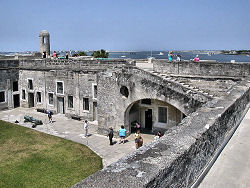
A view of the courtyard of the Castillo The British would make a few changes to
the fort, most notably its name, becoming Fort St. Mark. With Britain being the
dominating power in North America, it was not felt that the fort was needed to
be kept in first rate condition. This attitude was prevalent until the outbreak
of the American Revolution.
During the war, St. Augustine became the capital of the British colony of East
Florida. Improvements were begun on the fort, in keeping with its new role as a
base of operations for the British in the south. The gates and walls were
repaired and several rooms had second floors added to increase the housing
capacity of the fort. The Castillo saw action during the American Revolution
mainly as a prison, holding several patriots captured in Charleston when it was
taken by the British. Major operations from St. Augustine were kept under
control by the actions of the Spanish, who had declared war on Britain in 1779.
Bernardo de Gálvez, governor of Spanish Louisiana, attacked several British held
cities, capturing all of them. His actions kept the British occupied in the
south, never letting them organize any major actions against the Americans from
the Castillo.
At the end of the war, the Second Treaty of Paris returned Florida to Spain. On
July 12, 1784, Spanish troops returned to St. Augustine.
Second Spanish occupation
When Florida was returned to Spanish control, they found a much changed
territory. Many Spaniards had left Florida after the hand over to Britain, and
many British citizens stayed after the hand over back to Spain. Many border
problems arose between Spanish Florida and the new United States. Spain had
changed the name of the fort back to the Castillo de San Marcos, and continued
to build upon the improvements that Britain had made to the fort in an effort to
strengthen Spain’s hold on the territory. However, due to increased pressure
from the United States and several other factors, in 1821, Spain signed the
Adams-Onís Treaty, ceding Florida to the United States.
First American period
Upon the hand over to the United States, the Americans changed the name of the
Castillo to Fort Marion. Structurally, little was changed to the fort during
this time. Many storerooms were converted to prison cells, due to their heavy
doors and barred windows. Also, part of the moat was transformed into a battery
as part as the American Coastal Defense System. During the Second Seminole War,
Chief Osceola was jailed at the fort in 1837. Many other Native American tribal
peoples were held at the fort in later years.
The Confederate period
In December 1860, Florida seceded from the United States in the opening moments
of the American Civil War. Union troops had withdrawn from the fort, leaving
only one man behind as caretaker of the fort. In January 1861, Confederate
troops marched on the fort. The Union solder manning the fort refused to
surrender it unless he was given a receipt for it from the Confederacy. He was
given the receipt and the fort was taken by the Confederacy without a shot. Most
of the artillery in the fort was then sent to other forts, leaving the fort
nearly defenseless.
Second American period
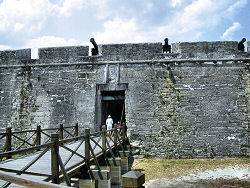
Castillo de San Marcos National Monument The fort was taken back by Union forces
on March 11, 1862 when the USS Wabash entered the bay, finding the city
evacuated by Confederate troops. The city leaders were willing to surrender in
order to preserve the town, and the city and the fort were retaken without
firing a shot. Throughout the rest of the fort's operational history, it was
used as a military prison. During the 1880s and 1890s many Native Americans were
imprisoned in the fort during the American expansion westward. In 1898, over 200
deserters from the Spanish-American War were imprisoned at the fort.
This marked one of the last actions at the fort as an operational base. In 1900,
the fort was taken off of the active duty rolls after 205 years of service,
under five different flags. In 1924, the fort was designated a National Monument
and in 1933 it was transferred to the National Park Service from the War
Department. In 1942, in honor of its Spanish heritage the name of the fort was
changed back to the Castillo de San Marcos. As an historic property of the
National Park Service, the National Monument was listed on the National Register
of Historic Places on October 15, 1966. The fort is co-managed with Fort
Matanzas National Monument. In 1975, the Castillo was designated an Historic
Civil Engineering Landmark by the American Society of Civil Engineers.
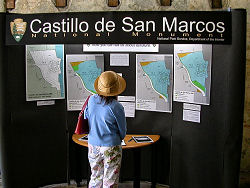
Since being transferred to the Park Service, the Castillo has been a tourist
attraction occupying 25 acres (101,000 m²) in downtown St. Augustine.