St. Augustine Florida vacation hotels, tours, sights


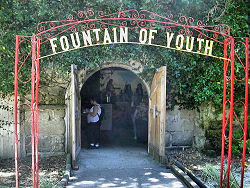
 Ponce de Leon's Fountain of Youth


St. Augustine Photo tours:

Sponsored Links:


 Return to The Florida Home Page

 © GoThere.com


From Wikipedia, the free encyclopedia
Fountain of Youth

The Fountain of Youth is a legendary spring that reputedly restores the youth of anyone who drinks of its waters. Florida is said to be its location, and stories of the fountain are some of the most persistent myths associated with the state.

A long standing myth is that Spanish explorer Juan Ponce de León was searching for the Fountain of Youth when he travelled to present-day Florida in 1513, but the story did not start with him, nor was it unique to the New World. Tales of healing waters date to at least the time of the Alexander Romance, and were popular right up to the European Age of Exploration. The later legend derives from the "Water of Life" tale in the Eastern versions of the Alexander Romance, where Alexander and his servant cross the Land of Darkness to find the restorative spring. The servant in that story is in turn derived from Middle Eastern legends of Al-Khidr, a sage who appears also in the Qur'an. Arabic and Aljamiado versions of the Alexander Romance were very popular in Spain during and after the period of Moorish rule, and would have been known to the explorers who journeyed to America.

Of course, there are countless indirect sources for the myth as well. Immortality is a gift frequently sought in legend, and stories of things like the philosopher's stone, universal panaceas and the elixir of life are common throughout Eurasia and elsewhere. An additional hint may have been taken from the account of the Pool of Bethesda in the Gospel of John, in which Jesus heals a man at the pool in Jerusalem.


The Arawaks and the land of Bimini
The native stories about the curative spring were related to the mythical land of "Beemeenee", or Bimini, a land of wealth and prosperity located somewhere to the north, possibly in the location of the Bahamas. According to legend, the Spanish heard of Bimini from the Arawaks in Hispaniola, Cuba, and Puerto Rico. Sequene, an Arawak chief from Cuba, had purportedly been unable to resist the lure of Bimini and its restorative fountain. He gathered a troup of adventurers and sailed north, never to return. Word spread among Sequene's more optimistic tribesmen that he and his followers had located the Fountain of Youth and were living in luxury in Bimini.

Bimini and its curative waters were widespread subjects in the Caribbean. Italian-born chronicler Pietro Martire Vermigli (Peter Martyr) told of them in a letter to the pope in 1513, though he didn't believe the stories and was dismayed that so many others did.


Ponce de León and Florida

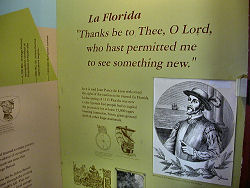
Ponce de León at the Fountain of YouthThe story continues that Juan Ponce de León heard of the fountain from the natives of Puerto Rico when he conquered the island. Growing dissatisfied with his material wealth, he launched an expedition to locate it, and in the process discovered Florida. Though he was one of the first Europeans to set foot on the American mainland, he never found the Fountain of Youth.

The story is apocryphal. While Ponce de León may well have heard of the Fountain and believed in it, his name was not associated with the legend in writing until after his death. That connection appears in the Memoir of Hernando D'Escalante Fontaneda in 1575, and in Antonio de Herrera y Tordesillas' history of the Spanish in the New World, based on Fontaneda. Fontaneda had spent 17 years as an Indian captive after being shipwrecked in Florida as a boy. In his Memoir he tells of the curative waters of a lost river he calls Jordan and refers to de León looking for them. However, Fontaneda makes it clear he is skeptical about these stories he includes, and says he doubts de León was actually looking for the fabled stream when he came to Florida.

It is Herrera who makes that connection definite in the romanticized version of Fontaneda's story included in his Historia general de los hechos de los Castellanos en las islas y tierra firme del Mar Oceano. Herrera states that native caciques paid regular visits to the fountain. A frail old man could become so completely restored that he could resume "all manly exercises… take a new wife and beget more children." Herrera adds that the Spaniards had unsuccessfully searched every "river, brook, lagoon or pool" along the Florida coast for the legendary fountain.[1] It would appear the Sequene story is likewise based on a garbling of Fontaneda.


Earlier versions of the legend
As noted above, the concept of a Fountain of Youth was not new to Europeans when they heard of it in the Caribbean. A Fountain or Well of Youth had appeared in the Alexander Romance, the Travels of Sir John Mandeville and writings related to Prester John long before the Old World became old. Explorers of the time had a habit of projecting onto newly-found places what they had read in books of fantastic travels, as demonstrated by the naming of Amazonia, the insistence that Ethiopia's king was Prester John, and the speculation that the Earthly Paradise was to be found in Asia, the Americas, or wherever its seekers happened to be looking. When the Spanish heard Indian stories of a youth-rendering spring in a land of plenty, they could not help but believe they had found the wonderful Fountain of Youth at last. Unfortunately, earlier Indian versions of the legend are not as well known, outside of what snippets Spanish chroniclers managed to preserve of what is sure to have been a rich tradition.


The Fountain of Youth today

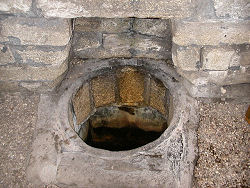
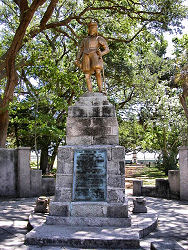
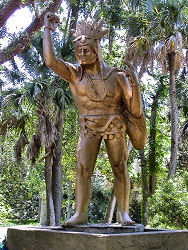
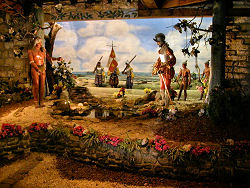
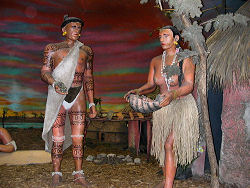
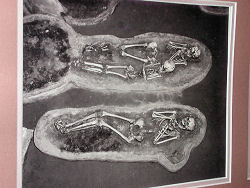
Postcard from the Fountain of Youth in St. AugustineThe city of St. Augustine, Florida is home to the Fountain of Youth National Archaeological Park, created as a tribute to the city's illustrious history at the spot which Ponce de León is traditionally said to have landed. Though the fountain situated there is not "the" Fountain, this does not stop tourists from drinking its water. The park exhibits native and colonial artifacts to celebrate St. Augustine's Timucuan and Spanish heritage.

The Fountain of Youth lives on as a metaphor for anything that potentially increases longevity. It is a frequently used plot device in age regression stories. Nathaniel Hawthorne used the Fountain in "Dr. Heidegger's Experiment" to demonstrate that positive thinking is a far better remedy than deluded journeys to Florida for mythical cures; Orson Welles directed and starred in a 1958 TV program based on the legend [1]; Tim Powers featured it in On Stranger Tides, a novel of 17th century voodoo adventure. In 1974 Marvel Comics featured the Fountain in Man-Thing and later The Savage She-Hulk, and in 2005 the Fountain turned up in the DC Comics series Day of Vengeance. Marvel also used the Fountain in the animated series Bigfoot and the Muscle Machines although its properties differed strikingly from its comics appearance. The fountain and its waters form the main plot device in Microsoft and Ensemble Studio's Age of Empires III campaign "Blood, Ice and Steel".