|
|
![]() |
![]() |
![]() |
![]() |
![]() |
![]() |
![]() |
![]() |
![]() |
![]() |
![]() |
![]() |
St. Augustine Photo tours: |
Sponsored Links: |
Return to The Florida Home Page
Lightner Museum
From Wikipedia, the free encyclopedia
St. Augustine City Hall and Lightner Museum.
Tower detail of the Lightner Museum.The Lightner Museum is a museum of
miscellaneous objects, mostly American Victorian, housed within a historic hotel
building in downtown St. Augustine, Florida, USA. The building is now listed on
the National Register of Historic Places.
The museum occupies three floors of the former Hotel Alcazar, commissioned by
Henry M. Flagler, and built in 1887 in the Spanish Renaissance style. It was
designed by architects Carrère and Hastings, who also designed the Ponce de León
Hotel across the street (now part of Flagler College). Both buildings are
notable as being among the earliest examples of poured concrete buildings in the
world. These architects later designed the New York Public Library and the U.S.
Senate office building. The hotel boasted a steam room, massage parlor,
gymnasium and sulfur baths, as well as the world's largest indoor swimming pool.
However, after years as an elegant winter resort for wealthy patrons, the hotel
closed in 1932. In 1946, Chicago publisher Otto C. Lightner purchased the
building to house his extensive collection of Victoriana. He opened the museum
two years later, and later donated it to the city of St. Augustine.
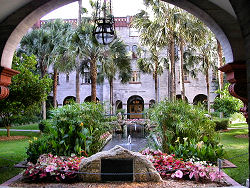
The building is an attraction in itself, centering on an open palm courtyard
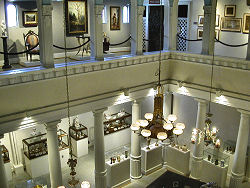
with an arched stone bridge spanning a fishpond. The Museum is housed in the
former health facilities of the hotel, i.e, the spa and Turkish bath, as well as
its three-storey ballroom.
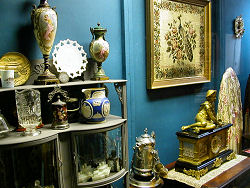
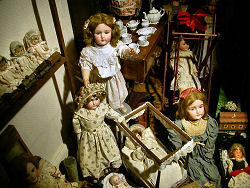
The museum's first floor houses a Victorian village, with shop fronts
representing emporia selling period wares; a Victorian Science and Industry Room
displays shells, rocks, minerals, and Native American artifacts in beautiful
turn-of-the-20th-century cases, as well as stuffed birds, a small Egyptian
mummy, model steam engines, elaborate examples of Victorian glassblowing, golden
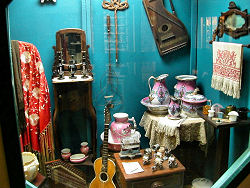
elephant bearing the world on its back, and a shrunken head; and a Music Room,
filled with mechanized musical instruments, dating from the 1870s through the
1920s.
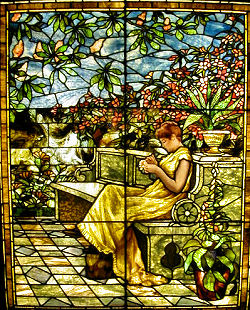
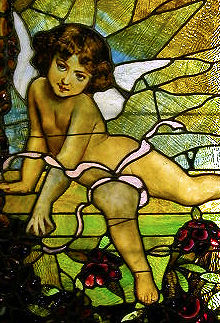
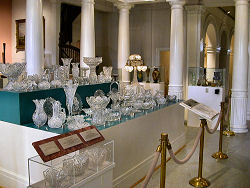
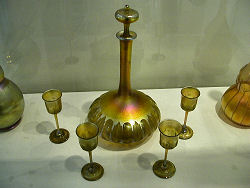
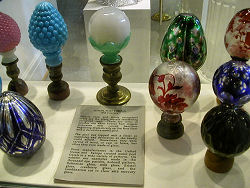
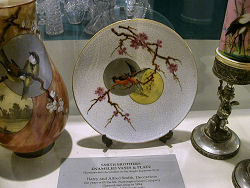
The second floor contains examples of cut glass, Victorian art glass and stained
glass work of Louis Comfort Tiffany's studio. The third floor, in the ballroom's
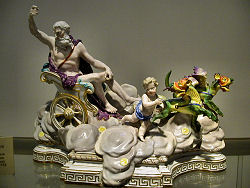
upper balcony, exhibits paintings, sculpture, and furniture, include a grande
escritoire created for Louis Bonaparte, King of Holland, in the period
1806-1810.