|
|
![]() |
![]() |
![]() |
![]() |
![]() |
![]() |
![]() |
![]() |
![]() |
![]() |
![]() |
![]() |
St. Augustine Photo tours: |
Sponsored Links: |
Return to The Florida Home Page
St. Augustine,
Florida
From Wikipedia, the free encyclopedia
Five flags have flown over St. Augustine since 1565. From left: the current U.S.
flag, the Confederate flag, the flag of the kingdom of Spain, the pre-1801
British flag, and the Burgundy Cross
St. Augustine in 1760, while under Spanish control
St. Augustine is a city in St. Johns County, Florida, in the United States.
It lies in a region of Florida known as the First Coast. According to the 2000
census, the city population was 11,592. In 2004, the population estimated by the
U.S. Census Bureau was 12,157 [1]. It is the county seat of St. Johns CountyGR6.
History
St. Augustine is the longest continually occupied European settlement in the
continental United States; a few were founded prior to St. Augustine but all
failed, including the original Pensacola colony in West Florida (First founded
in 1559) — which was wiped out by a hurricane a mere two years after its
founding, and Fort Caroline in what is today Jacksonville, Florida in 1564. The
city was founded by the Spanish admiral Pedro Menéndez de Avilés on August 28,
1565, the feast day of Augustine of Hippo, and consequently named by him San
Agustín. This came 21 years before the English settlement at Roanoke Island, in
Virginia Colony, and 42 years before the successful settlements of Santa Fe, New
Mexico, and Jamestown, Virginia.
In 1586 St. Augustine was attacked and burned by Sir Francis Drake. In 1668 it
was plundered by pirates and most of the inhabitants were killed. In 1702 and
1740 it was unsuccessfully attacked by British forces from their new colonies in
the Carolinas and Georgia. The most serious of these came in the latter year,
when James Oglethorpe of Georgia allied himself with Ahaya the Cowkeeper, chief
of the Alachua band of the Seminole tribe to lay siege to the city.
In 1763, the Treaty of Paris ended the French and Indian War and gave Florida
and St. Augustine to the British, an acquisition the British had been unable to
take by force and keep due to the strong fort there. St. Augustine came under
British rule and served as a Loyalist (pro-British) colony during the American
Revolutionary War. A Treaty of Paris in 1783 gave the American colonies north of
Florida their independence, and ceded Florida to Spain in recognition of Spanish
success during the war.
Florida was under Spanish control again from 1784 to 1821. During this time,
Spain was being invaded by Napoleon and was struggling to retain its colonies.
Florida no longer held its past importance to Spain. The expanding United
States, however, regarded Florida as vital to its interests. In 1821, the Adams-Onís
Treaty peaceably turned the Spanish colonies in Florida and, with them, St.
Augustine, over to the United States.
Florida was a territorial possession of the United States until 1845 when it
became a U.S. state. In 1861, the American Civil War began and Florida seceded
from the Union and joined the Confederacy. Days before Florida seceded, state
troops took the fort at St. Augustine from a small Union garrison (January 7,
1861). However, federal troops loyal to the United States Government quickly
reoccupied the city (March 11, 1861) and remained in control throughout the
four-year-long war. In 1865, Florida rejoined the United States.
Public Square, St. Augustine, ca. 1858.Spanish Colonial era buildings still
existing in the city include the fortress Castillo de San Marcos. The fortress
successfully repelled the British attacks of the 18th century, was occupied by
Union troops during the American Civil War, and later served as a prison for the
Native American leader Osceola. It is now the Castillo de San Marcos National
Monument.
In the late 19th century the railroad came to town, and led by northeastern
industrialist Henry Flagler, St. Augustine became a winter resort for the very
wealthy. A number of mansions and palatial grand hotels of this era still exist,
some converted to other use, such as housing parts of Flagler College and
museums. Flagler went on to develop much more of Florida's east coast, including
his Florida East Coast Railway which eventually reached Key West in 1912.
The city is a popular tourist attraction, for the rich Spanish Colonial Revival
Style architectural heritage as well as elite 19th century architecture. In 1938
the theme park Marineland opened just south of St. Augustine, becoming one of
Florida's first themed parks and setting the stage for the development of this
industry in the following decades.
Geography
Location of St. Augustine, Florida
St. Augustine is located at 29°53′39″N, 81°18′48″W (29.894264, -81.313208)GR1.
According to the United States Census Bureau, the city has a total area of 27.8
km² (10.7 mi²). 21.7 km² (8.4 mi²) of it is land and 6.1 km² (2.4 mi²) of it
(21.99%) is water.
Access to the Atlantic Ocean is via the St. Augustine Inlet of the Matanzas
River.
Attractions
Flagler College, St. Augustine, FloridaThe Alligator Farm.
Castillo de San Marcos.
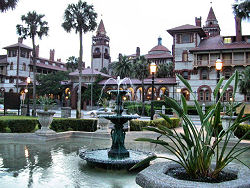
Flagler College, with the former Ponce de Leon Hotel.
Ghost tours, hauntings and more, from the corner of Charlotte and Cuna Streets.
Lightner Museum, in the former Hotal Alcazar.
Ripley's Believe it or Not! Musuem.
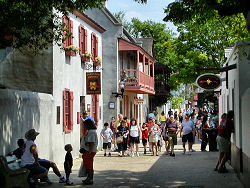
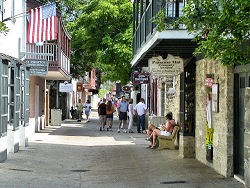
Saint George Street.
St. Augustine Lighthouse and Museum
World Golf Village & Golf Hall of Fame
Demographics
As of the censusGR2 of 2000, there were 11,592 people, 4,963 households, and
2,600 families residing in the city. The population density was 534.7/km²
(1,384.6/mi²). There were 5,642 housing units at an average density of 260.3/km²
(673.9/mi²). The racial makeup of the city was 81.21% White, 15.07% African
American, 0.41% Native American, 0.72% Asian, 0.09% Pacific Islander, 0.88% from
other races, and 1.61% from two or more races. Hispanic or Latino of any race
were 3.11% of the population.
There were 4,963 households out of which 18.6% had children under the age of 18
living with them, 37.4% were married couples living together, 12.4% had a female
householder with no husband present, and 47.6% were non-families. 36.7% of all
households were made up of individuals and 14.5% had someone living alone who
was 65 years of age or older. The average household size was 2.11 and the
average family size was 2.76.
In the city the population was spread out with 16.1% under the age of 18, 15.3%
from 18 to 24, 23.9% from 25 to 44, 25.2% from 45 to 64, and 19.5% who were 65
years of age or older. The median age was 42 years. For every 100 females there
were 84.6 males. For every 100 females age 18 and over, there were 81.4 males.
The median income for a household in the city was $32,358, and the median income
for a family was $41,892. Males had a median income of $27,099 versus $25,121
for females. The per capita income for the city was $21,225. About 9.8% of
families and 15.8% of the population were below the poverty line, including
25.8% of those under age 18 and 10.0% of those age 65 or over.
Notable residents
Scott Lagasse Jr., NASCAR driver
Ray Charles. Legendary pianist.